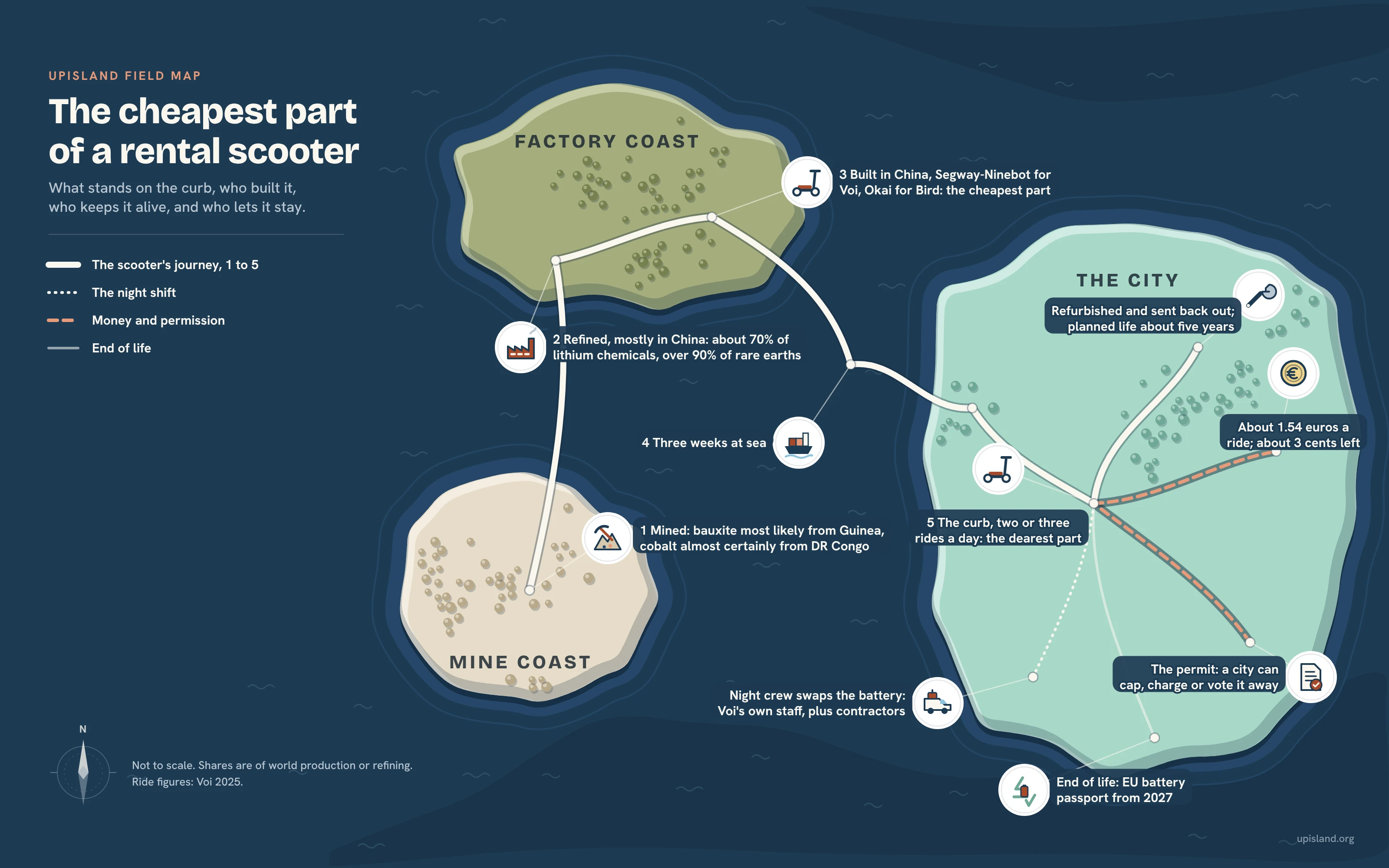
What stands on the curb, who built it, who keeps it alive, and who lets it stay.
It is a little after six in the morning. On the curb of a European city street, a rental scooter waits for its first rider.
Overnight someone swapped its battery. In the app it now shows as available, with a full charge. Today it will be ridden two or three times. Each ride will last about ten to twelve minutes and cover about two kilometers. Then, in the evening, someone will come for the battery again.
The deck carries the name Voi. This particular scooter is our invention, but nothing that happens to it is invented: every circumstance below is on the record for scooters like it, in fleets like this one.
Most people who pass it see a gadget a company has left on the sidewalk. Follow it backwards and forwards for a day and it turns into a long chain of mines, factories, ships, night shifts, small payments and city votes. The scooter is the cheapest link in that chain. It is also the only one anybody sees.
Start with what it is made of.
The essay as a map. Follow the scooter from 1 to 5; the dotted line is the night shift, the dashed lines are money and permission. Not to scale. Open full size.
Read the map as text
On Mine Coast, the scooter’s materials are mined: bauxite most likely from Guinea, cobalt almost certainly from the Democratic Republic of the Congo. On Factory Coast they are refined, mostly in China (about 70 percent of lithium chemicals, over 90 percent of rare earths), and the scooter is built in China: Segway-Ninebot builds for Voi, Okai built for Bird. The scooter is the cheapest part. It spends three weeks at sea. In the City it stands on the curb and is ridden two or three times a day; the curb is the dearest part. A night crew of Voi’s own staff, plus contractors, swaps the battery. Money and permission meet at the curb: a ride earns about 1.54 euros and leaves about three cents, and the city can cap, charge or vote the permit away. Scooters are refurbished and sent back out, with a planned life of about five years; at the end of life, an EU battery passport applies from 2027.
A shared scooter today weighs about 32 kilograms, twice as much as the first rental models, and carries a swappable battery of about 0.7 kilowatt-hours, double theirs. The extra weight buys durability. A detailed inventory of an earlier, 22-kilogram rental model gives a sense of the parts: about eleven kilograms of aluminum, mostly in the frame, two and a half kilograms of steel, a little over two kilograms of battery cells, and a motor of about two kilograms built around permanent magnets.
Each of those materials has a home address, and most of the addresses are far from the curb. The bauxite for the aluminum most likely comes from Guinea, the largest producer. It is turned into metal mostly in China, which smelts about six in every ten metric tons of the world’s aluminum. The cobalt in the battery, if the cells use cobalt, almost certainly comes from the Democratic Republic of the Congo, which mines nearly three quarters of it. The nickel comes mostly from Indonesia, the graphite mostly from China, the lithium from Australia, China or Chile.
Then nearly everything passes through China again to be refined. China turns out about 70 percent of the world’s lithium chemicals and nearly 80 percent of its refined cobalt. For rare earths and battery graphite, its share is above 90 percent. It also makes 94 percent of the sintered magnets that sit in motors like this one.
No source tells us exactly how much of each metal is in this scooter. A rough calculation for a typical battery chemistry gives about 50 grams of lithium, 50 grams of cobalt and 400 grams of nickel. Small amounts. Each of them took a mine, a refinery and an ocean crossing to arrive.
The clocks in this chain run at very different speeds. The ore took millions of years to form. The refinery took weeks. The factory will take one to two months to build the scooter. The ship will take three weeks to bring it to Europe. A ride takes ten minutes.
The name on the deck says Voi, a Swedish company. Voi did not build this scooter.
Voi says so itself, in the place where companies have to be precise: the prospectus it filed in 2025 to sell bonds, approved by the Swedish financial regulator. “Voi sources its e-scooters and e-bikes from Segway-Ninebot who manufacture the vehicles in China,” it reads. The connected module that lets the app find and unlock the scooter is also made in China. The battery cells are made by Samsung and packed by the same Chinese manufacturer. Germany’s vehicle approval register lists Voi’s current scooters under a type code, D110, that the manufacturer also uses for its own sharing model.
Voi still shapes the scooter. It writes the scooter’s software and its connected platform in house, specifies the vehicle, and says it developed it together with the factory. The prospectus also names the cost of that arrangement: the software is tuned to one kind of hardware, so changing factories would be slow and expensive. Voi owns the design brief, the code and the riders. The factory belongs to someone else.
We have not stood in that factory. Every step below comes from Voi’s own filings and reports. An order is placed, priced in US dollars. In China, the manufacturer builds the scooter, fits the connected module, and packs the battery around Samsung cells. That takes one to two months. Voi does not own the plant, but it watches it: its head of sustainability traveled to China to visit the manufacturer and its key suppliers, and Voi reports that solar panels at its main production site now cover 81 percent of the site’s electricity. Then the scooters go into containers and onto a ship. Three weeks later they reach Europe. Somewhere in that journey the scooter acquires a Swedish name. It never acquires a Swedish address.
Across the industry the picture looks the same, with two exceptions. Lime’s chief executive put it plainly in 2022: competitors “buy from the same two Chinese manufacturers.” The records name them. Segway-Ninebot builds for Voi, for Bird since 2025, for Ryde in Norway and for Tier’s last generation, and it is designing the next scooter for Whoosh in Russia. Okai, a private company in Zhejiang province, built Bird’s earlier scooters; a 2024 court order in Bird’s bankruptcy lists its contracts.
The exceptions are the largest fleet and one of the most ambitious. Lime designs its own vehicles and says it buys from neither of the two. Its own staff supervise production on site. Its American import records run through a trading house in Taiwan and bicycle and parts factories in China, Cambodia and Vietnam. Bolt designs its scooters and assembles them in Estonia.
The manufacturer behind many of Europe’s scooters is itself an unusual company. Ninebot, a Chinese company, bought the American company Segway in 2015, a few months after Segway had accused it of copying its patents. Today its two founders control most of the votes. Xiaomi, an early investor, now holds 3.5 percent. Sharing fleets are a small part of the business: Ninebot’s sales to business customers of every kind made up less than a tenth of its revenue in 2025. More than half of its revenue comes from electric mopeds and e-bikes. Its factories run on more people than its payroll shows. In 2025 Ninebot employed about 2,000 production workers of its own and bought in some 18.6 million hours of outsourced labor, roughly the work of 9,000 more. For the company that builds them, Europe’s rental scooters are a side line. For an operator like Voi, that side line is the whole fleet.
The scooter on the curb has had a busy night.
Somebody took out the empty battery, put in a full one, checked the brakes and maybe moved the scooter to a better corner. Shared fleets run on this work, and operators get it done in three ways.
Some employ the crews. Voi had 813 employees on average in 2025, about seven for every thousand scooters and bikes on the street, and it uses outside contractors on top for maintenance and charging. Others pay local contractors a share of each scooter’s earnings. Dott, which absorbed its rival Tier, moved two thirds of its markets to that model in 2025.
The third way is the one the industry started with and left behind. In 2019 Lime paid independent “juicers” in Berlin between 4.30 and 4.90 euros to collect a scooter, charge it at home overnight and put it back by seven in the morning. A consumer group that signed up undercover found the contract put all the risk on the juicer. In California the same model ended in an 8.5 million dollar settlement in 2021.
Some scooters need more than a battery. In December 2025 Voi opened a refurbishment hub in Poznań, Poland, where vehicles are taken apart, repaired and sent back out, motors and connected modules included. Dott says its own program refurbished 9,700 scooters in 2024 and stretched their average life to 11,000 kilometers. Early life-cycle studies assumed a rental scooter would last a year or two. Operators now plan for five.
Here the usual picture turns over. The scooter looks like the business. It is the cheap part.
Lime, the largest operator, paid on average about 1,300 dollars for each vehicle in 2025, including the battery, shipping, insurance, import duties and tariffs. It says a vehicle earns that back in about twelve months, and it writes scooters off over five years. Dott’s latest order works out at about 590 euros a vehicle. Nobody would build a company on an asset that cheap if the asset were the hard part. A scooter is easy to buy. A ride that pays is hard to sell.
The hard part is making each ride pay. Voi carried 115.8 million rides in 2025 and earned 178.2 million euros, about 1.54 euros a ride. Divide Voi’s own reported costs by its rides and you see roughly where that money goes. Spare parts and handling the vehicles take 36 cents. The people who maintain and charge them take 22. Other vehicle costs, card fees included, take 8. Running each city market, from marketing and insurance to the local team, takes 35. Headquarters takes 28. Wear on the vehicle itself takes 23. About three cents a ride is left.
A rental scooter, in other words, is a coin-operated machine whose coins are mostly spent before they reach the till.
Prices tell the same story from the rider’s side. Voi’s revenue per ride fell from about 1.78 euros in 2024 to 1.54 in 2025, because more riders bought passes, which made up 39 percent of its revenue. Other channels take their share. Lime gets about one in seven of its revenue dollars through Uber’s app, and the fee Uber charges on that revenue rose from about six to about twelve percent in two years.
A rental scooter, in other words, is a coin-operated machine whose coins are mostly spent before they reach the till.
The scarcest thing in this chain is the piece of curb.
A scooter may only stand where a city allows it, and cities have learned to ration that permission. In April 2023 Paris held a vote on rental scooters. About 103,000 people took part, 89 percent voted against, and the city’s 15,000 scooters were gone by September. Stockholm cut its operators from three to two in 2026 and kept the total fleet at 12,000; Voi stayed, Lime had to leave. Helsinki went from five operators to three and capped its inner city at 4,700 scooters.
Other cities set the terms through fees and checks. Zurich charges ten francs per scooter per month for the use of public ground, and in March 2026 a court confirmed that it may. Chicago makes every scooter model pass an in-person inspection before it issues a license. Oslo went the other way. It doubled its cap to 16,000 in 2025, and then saw scooter injuries more than double compared with two years earlier.
A permit is a strange kind of asset. It exists because a city council agrees that it does. Take the council’s signature away and every scooter in the city becomes scrap metal with an app attached, however well it is built.
That is why operators fight hardest over tenders. Losing one takes a company’s whole fleet off a city’s streets at once, as Lime found in Stockholm.
Behind the permit sits the money that bought the fleet.
In the spring, the largest operator looked fragile. In its listing documents in May 2026, Lime warned that it did not have the cash to repay about 846 million dollars of debt due within a year, and that there was substantial doubt it could continue as a going concern. The warning is gone. When Lime listed on Nasdaq in July 2026, most of that debt turned into shares. Lime paid off a 115 million dollar loan that Uber had guaranteed and took a new bank credit line. Uber now owns about 23 percent of the company.
The fragile balance sheet in the industry today belongs to Dott. At the end of July 2026 it had about 10 million euros in cash against about 69 million in borrowings, and it needed its bondholders’ consent twice to delay its accounts.
The factory sits on the safe end of this arrangement. It is paid when the scooter ships, and the manufacturer behind many of Europe’s fleets earns about 40 percent gross margin on what it sells to business customers. The operator carries the risk of whether the scooter will be ridden, allowed and repaired for long enough to pay for itself.
That leaves the climate.
It depends on two things: what the ride replaces, and how long the scooter lives. In Oslo, six in ten riders said they would otherwise have walked, and about a quarter would have taken public transport. Only about one in twelve would have taken a car or a taxi.
A study by ETH Zurich, using GPS tracks of more than 500 travelers, found that shared scooters there emit more carbon dioxide than the trips they replace, while privately owned scooters emit less. The reason is the life cycle. A German study in 2020 found that most of a shared scooter’s footprint comes from making it. Even in its best case, a scooter of that generation stayed above the emissions of the trips it replaced.
Two things have changed since. Scooters live longer: Lime now plans for five years, and Voi says its newest vehicles can last ten. And in places where scooters have been around longer, they replace more car trips. England’s national evaluation of its rental trials found that the share of scooter trips replacing a car, van or taxi rose from 12 to 21 percent as the trials matured, while the share replacing walking fell.
The end of a scooter’s life is changing too. From February 2027, every battery like the one in this scooter will need a digital passport in the European Union, and collection targets for these batteries rise to 61 percent by 2031. A battery or a motor that goes back into service from a refurbishment hub does not need to be mined, refined and shipped again.
So the honest answer is conditional. A shared scooter that is built well, repaired often and ridden instead of a car is good for the climate. A scooter that dies young and replaces a walk is not. The same machine can be either. What decides it is everything around the machine.
It is night now, on the same curb.
The scooter has done its rides, two or three on an average day. Someone from the night crew arrives, takes out the battery and slides in a fresh one. In the morning the app will show the scooter as available again.
From the sidewalk it looks exactly as it did twelve hours ago. It is a Chinese-built platform under a Swedish name. It carries aluminum smelted in China, cobalt most likely mined in the Congo and cells made by Samsung, and it runs code that Voi writes itself. It earns about a euro and a half a ride and keeps about three cents. It stands on a piece of public ground the city lends for a fee, under a permit that a council can withdraw with a vote.
The scooter is the cheapest part of all this. The curb is the dearest.