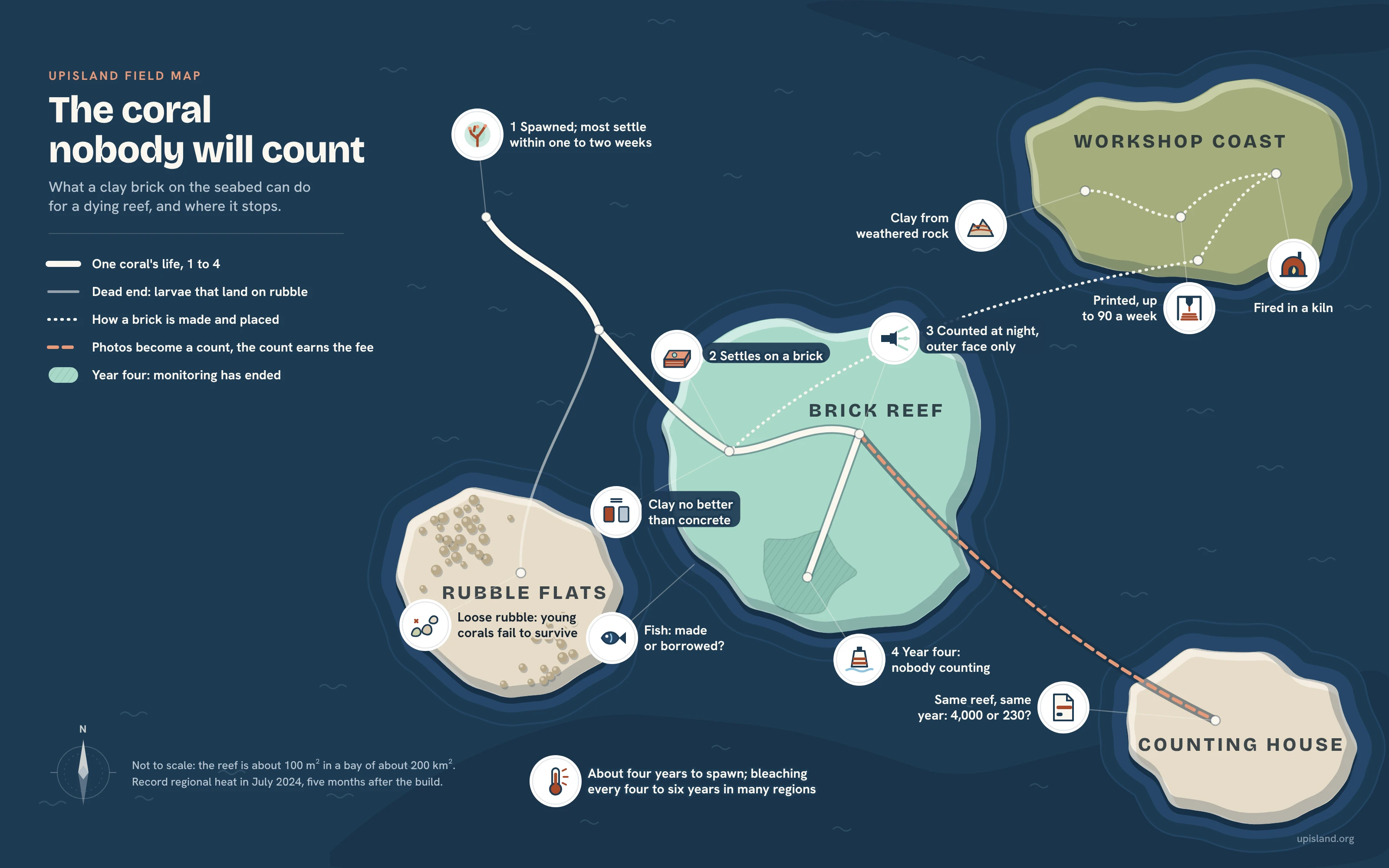
What a clay brick on the seabed can do for a dying reef, and where it stops.
It is night in Pujada Bay, off the southeastern coast of Mindanao, and a diver is taking a photograph of a brick.
The brick lies four and a half meters down. It is one of 822 bricks stacked into a reef that covers about a hundred square meters. The diver finds the brick’s small numbered tag, holds a camera square to the brick’s long outer face, and switches on an ultraviolet lamp.
Small specks on the clay begin to glow.
Each speck is a coral. Young corals are hard to see with the naked eye, which is why the counting happens at night: ultraviolet light brings out their fluorescence. The diver does not count them here. The photograph goes back to a laptop, where someone will circle each speck and measure it.
One of those specks is the coral this essay follows. We made it up as an individual, but nothing that happens to it is made up: every circumstance below happened, on the record, to corals like it on reefs like this one. When the diver takes the picture, our coral is about six months old and about the size of a pea. It is, for now, a success.
To see why a glowing speck on a printed brick is worth a night dive, and why it is less than it looks, start with what a coral is.
The essay as a map. Follow the coral from 1 to 4; the dashed line is how photos become a count, and the count becomes a fee. Not to scale. Open full size.
Read the map as text
The coral is spawned in open water, and most larvae settle within one to two weeks. Larvae that land on loose rubble fail to survive. Ours settles on a printed clay brick on the Brick Reef (2), is counted at night on the brick’s outer face only (3), and reaches year four, when the monitoring has ended (4). On Workshop Coast, clay from weathered rock is printed, up to 90 bricks a week, and fired in a kiln. Independent studies find the clay no better than concrete, and whether the reef makes fish or borrows them is unmeasured. Far away, at the Counting House, the same reef and year were reported as about 4,000 and about 230 young corals. A coral needs about four years to spawn; bleaching returns every four to six years in many regions, and the region had record heat in July 2024.
A coral looks like a rock and grows like a plant. It is an animal. To be exact, it is a colony of hundreds to thousands of small, soft-bodied animals called polyps, each one a jellyfish-like creature that builds a cup of limestone around itself. Polyps grow, die and are built over by new ones. Over centuries, the cups pile up into a reef.
Most reef corals are also farmers, and the farm is inside their own bodies. Microscopic algae live in their tissue, use the coral’s waste to photosynthesize, and pay their rent in food. When the water gets too hot, the arrangement breaks down. The coral expels the algae and turns white. That is bleaching. A bleached coral is not dead yet, but it has lost its main source of food, and it is far more likely to die.
Reefs matter well beyond the coral. They cover about a tenth of a percent of the ocean floor and, by a widely cited estimate, hold at least a quarter of all marine species. More than a billion people depend on them for food or income. A reef in good shape takes the force out of waves before they reach the shore, cutting their energy by 97 percent on average.
Our coral’s life began the way most do, on a spawning night. Most stony corals release eggs and sperm into the water at once, in mass, synchronized events. The fertilized eggs become larvae that drift with the current. They need a few days before they can settle at all. Most settle within one to two weeks, and some can still settle months later. A larva that is ready to settle looks for two things: hard ground that will not move, and the right chemical signal. The strongest known signal comes from a crust of coralline algae that grows on healthy reef rock.
Hard ground is where the trouble starts.
When corals die, the reef does not stay standing. Organisms that bore into rock hollow out the dead skeletons, and they break apart. Half of all dead coral colonies fall apart within about three years; four in five are gone within five. Across the Caribbean, the most complex reefs, the ones with the most nooks and overhangs, have nearly disappeared since 1969. What is left behind is rubble.
Rubble is a normal part of a reef. Usually it cements over time into new, solid ground. After repeated or severe damage, it stays loose and unstable instead. On loose rubble, young corals fail to survive. A larva can drift for days, find a spot, cling on, and lose it all when the ground shifts.
Then there is the second problem. Dead corals do not spawn. After heat killed adult corals across the Great Barrier Reef in 2016 and 2017, the number of new corals settling there in 2018 fell 89 percent below historical levels. Fewer parents means fewer larvae, and the few larvae that come land on ground that kills them.
Under both problems sits a third, the one nothing on the seabed can touch. The water keeps warming. The Intergovernmental Panel on Climate Change projects that coral reefs will decline by a further 70 to 90 percent at 1.5°C of warming, and by more than 99 percent at 2°C.
So much for the fall. Now the brick.
The brick our coral settled on began as a mountain.
That is only a slight exaggeration. Clay is what rock becomes when it has been rained on for long enough. Feldspar and mica, common minerals in rocks such as granite, weather over geological time into the fine minerals that make clay. Most of that happens on land, and much of it is carried toward the sea. Seen that way, the brick is going home.
The last part of the trip takes a few weeks. We have not stood in the workshop; every step below comes from the company’s and its partners’ own descriptions.
The company is rrreefs, which started in Zurich in 2020 as an association. For its reefs in the Philippines, the clay is dug in the region. Brick clay is usually stacked in layers and left outside so the rain can wash out its salts, then ground and mixed with water and sand.
The paste goes to a workshop in Mati, on the campus of the state university that is the company’s partner on the Pujada reef. There, a printer pushes it through a nozzle, layer on layer, the way a baker pipes icing onto a cake. When the company printed its first prototypes in 2021, a smaller brick took an hour and twenty minutes to print and then dried for two or three weeks before it was fired. Today’s brick is bigger: about seven and a half kilograms, the weight of a sack of potatoes, with printed ridges meant to give young corals somewhere to hide. The workshop is run by trained local staff and can make up to 90 bricks a week. When a batch is dry, it goes into the kiln.
The people who will build with the bricks practise on dry land. The company’s reef builders start on small model modules, then move to full-size ones, before they build a real reef underwater. Twelve of them finished that training in 2025. On the seabed, a foundation of cast concrete is set and anchored. Then the bricks go down, hundreds of them, and divers stack them until the structure covers about a hundred square meters.
Design, sales and the reports stay in Zurich, with a team of about ten. The rest of the work, from printing to building to much of the counting, is done in the Philippines by local staff, scientists, fishers and divers. The idea, in the company’s words, is that new corals settle on the reef naturally.
The reef our coral lives on was built in February 2024. For a coral larva, it was exactly what the bay had been missing: hard ground that stays put.
And the corals came. In the company’s first report on the reef, the density of young corals on the photographed bricks nearly tripled within six months, from 13 to 34 per square meter. Fish came faster still. Within five months, the company measured ten times as much fish, by weight, around the reef as at a control patch of seabed nearby. The protected area around the reef was turned into a no-take zone because of the new reef.
This part of the story holds up, and it matters. Where the seabed has turned to loose rubble or bare sand, and larvae are still drifting in the water, a stable structure fixes the one thing that is broken. That is also what people mean when they say a reef like this “buys time.”
The brick cannot cool the water. What it can do is keep wild corals breeding in one place for a while. A coral grown from a larva is a new genetic mix, unlike a fragment cut from a parent colony, which is a clone. One model of reefs under warming found that, with enough natural genetic variety and enough time, corals could adapt to the heat. Every new generation is another draw. The brick keeps the draws coming while the climate is decided somewhere else. One of the company’s founders calls this emergency care, and the phrase is honest.
If the story ended here, it would be a good one.
It doesn’t. The ground gives way a second time, in four places.
The first is the clay. The company says the porous fired clay attracts larvae and lets corals attach more firmly. Independent studies do not bear that out. In Indonesia, concrete and terracotta panels collected statistically indistinguishable numbers of young corals over a year; the site mattered and the material did not. In a tank experiment comparing ceramic, limestone and concrete tiles, concrete came out best once survival was counted. In Kenya, concrete modules held the most young corals after two years. The material, in other words, matters less than the company says.
The shape may matter more than anyone has checked. In Hawaii, researchers printed clay modules, fired them in a kiln, and gave some of them small spiral recesses. Those drew about 80 times more young corals than plain control modules and kept 20 to 50 times more of them alive after a year. Whether the shape of the rrreefs brick does anything like that is unknown. As far as the published record shows, it has never been tested against a plain block.
The second is the fish. They arrived fast, but nobody knows from where. Over the first year, divers counted more fish species on the reef than at the control, 45 against 22, and local partners report young fish settling there. But the company’s water samples, which pick up traces of DNA that animals shed, found about as many species at the control as at the reef, and by the end of the second year the control had caught up on the divers’ count too. The weight of fish swings as well. In the company’s own published summaries, it climbed to a peak in the reef’s second year and by the following February had fallen back to about a quarter of that, still several times the control. A reef that produces new fish and a reef that borrows them from next door look the same on a fish count. What the reef has done for the bay’s fish, the real impact, is unknown. Nobody has measured it.
The third is the count, and this is where our coral matters most, because it is not only an animal. It is a number.
Here is how the number is made. A random sample of bricks is tagged when the reef is built. At each survey, a diver photographs the long outer face of each tagged brick at night, and someone counts the glowing specks on a screen. In the company’s earlier reports, that density was then multiplied up to the whole reef. In the 2025 report, that method gave about 4,000 young corals on this reef after one year. The 2026 report, covering the same reef and the same year, gives about 230.
The likeliest explanation, on our reading of the two reports, is mundane: the newer report gives the count on the photographed bricks themselves, and the older one estimated the whole reef. The 2026 report does not say that the method changed. Shortly before it came out, the company’s pitch to investors still promised 4,000 to 15,000 new corals per hundred square meters in the first year.
There is a quieter assumption under the multiplication, too. It treats the faces nobody photographs as if they were as crowded as the one that is. In the Indonesian study, significantly more young corals settled on the hidden back side of the panels than on the front. Our coral, on the outer face, is the one that gets counted. Its siblings in the shade may be more numerous, or fewer. Nobody looks.
To its credit, the company says in its own reports that each reef is compared against a single control site, a design dictated by money, time and sponsor requirements. That limits what any of its numbers can prove.
The count matters because of what is for sale. Companies that sponsor a reef pay upfront for the build, then yearly for monitoring and a biodiversity report. The brick is the cheap part. What the sponsor really buys is three years of counting.
That gives the number a strange kind of power. Our coral does not know it has been counted. It would grow, or die, the same way without the photograph. The number lives somewhere else: in a report, in a pitch to investors, in a sponsor’s sustainability page. Yet the number, and not the coral, is what ties a company in Europe to a brick in the Philippines. Take the number away and the coral carries on. The arrangement around it does not. So the count is the product, and the product is soft at exactly the point where it is worth the most.
The fourth crack is the clock, and it is the deepest.
Our coral needs about four years before it can spawn. Corals reach that point more by age than by size. In one Caribbean study, colonies raised from larvae were sexually mature at four. Most will not get there. On the company’s oldest reef, off the Colombian island of San Andrés, 35 of every hundred young corals were still alive after a year. Nobody counted after that.
Meanwhile, the gap between severe bleaching events has shrunk. Across a hundred reef locations, the typical interval had fallen to six years by 2016, which researchers describe as too short for mature reefs to recover in full. The latest global report on the state of coral reefs puts it at four to six years in many regions since 2010. Between 2023 and 2025, 84 percent of the world’s reefs went through heat strong enough to bleach them. At San Andrés, the heat came in 2023. It struck the company’s reef there and the natural reefs around it; the island’s elkhorn coral died in large numbers. Our coral did not have to wait. The reef went in in February 2024. By late May, the satellite station that tracks heat stress for the reefs of the southern Philippines had raised a bleaching alert. In July it recorded the highest heat stress in its record, which goes back to 1985, at the level where NOAA warns of reef-wide bleaching and deaths among heat-sensitive corals. The reading covers a whole region, not this reef, so it cannot say what happened four and a half meters down in Pujada Bay. Nobody else has said either. The company’s reports on the reef do not mention heat or bleaching at all. Our coral was photographed glowing in its first summer, in the hottest water the region had on record. Whether it bleached, the record does not show.
Put the clocks side by side. The clay took geological time to form. The brick took weeks. The coral needs four years to grow up. Around Pujada Bay, the heat has reached alert level four summers running.
Then there is the end of the contract. Monitoring runs for three years. The yearly fees run with it. No plan has been published for what happens to a given reef after that. The company says it is training local reef builders to carry the work on; it has not said who will count, or pay, once the three years are up. Three years is also short for a coral. On printed terracotta reefs in the Gulf of Aqaba, the fish settled into a steady population after about a year, while the corals still had not after nearly three. Tree planting knows this failure well. In Sri Lanka, of roughly a thousand hectares of mangroves under restoration, only about two hundred took, and survival tracked whether anyone looked after the plants once they were in the ground.
Take the number away and the coral carries on. The arrangement around it does not.
So what is the brick?
It is a real object doing a real, small job. It gives larvae ground that holds still, in places where that is what is missing. It is built by people who live near the reef, and somebody comes back to count, with a method the company publishes, limits included. Those are real virtues in a field where the typical project covers a hundred square meters and most are watched for less than eighteen months.
It is also no more than that. It covers a hundred square meters of a protected bay of about two hundred square kilometers. The water stays as warm as it was, the clay is ordinary clay, and the numbers need more care than the marketing gives them.
What would make it enough is mostly outside the brick. Whether young corals become a reef depends heavily on who grazes the algae that compete with them. After the 1998 bleaching, coral cover almost doubled in three years on reefs where large plant-eating fish were present. Where those fish were kept out, seaweed took over. Protecting a reef is cheaper than rebuilding one. One reef ecologist put it plainly: “It is much more cost-efficient to prevent degradation of reefs in the first place than having to restore the damage afterwards.” And the counts would be worth more if someone other than the company made them, on more than one control site, with the method stated every time.
Since 27 September 2026, European consumer law has taken the reader’s side on this. It bans generic environmental claims such as “eco-friendly” unless a company can show recognized excellent environmental performance, and it bans environmental claims about a whole business that rest on one activity. A sponsor can truthfully say it funds a hundred square meters of reef in Pujada Bay, monitored for three years. A sponsor that calls itself nature-positive because of that reef is on thinner ground. Anyone looking at an “adopt a coral” offer can ask the same three questions. What exactly was built, and where? Who counts, and how? And what happens in year four?
It is night in Pujada Bay again, four years after the reef was built. No diver comes. The monitoring ended a year ago.
The brick is still there. Fired clay, the company says, will not dissolve as the ocean turns more acidic, the way limestone will. If our coral survived the first year that killed most of its siblings, and whatever heat came while it was young, it is now about old enough to spawn. On the right night it will release its eggs and sperm into the water, and new larvae, new mixes, will drift off looking for hard ground.
Some of them will find a brick. Nobody will photograph them.
A clay brick on the seabed can keep a few wild corals breeding for a few years. That is real, and it is all it is. The rest depends on the water.
How this was made. Every fact in this piece traces to a source we saved and checked in a separate pass: six research rounds, the last one with independent agents trying to refute the essay. Company figures are the company’s own and are attributed as such; where the record is silent, we say so.