That question runs through this piece. Here is the short answer. Resilience is real, and it means something other than what the posters say. Four things people often name for it hold up unevenly. Two of them hold. One matters mostly through the way it goes wrong. One has barely been tested.
First, a working definition, because the word has been worn thin. In this piece, resilience means staying functional while the ground shifts, and rebuilding a workable life on the changed ground.
1. Why "back" is harder to find
The futurist Jamais Cascio describes the present with four letters, BANI: brittle, anxious, nonlinear, incomprehensible. His definition of the first one is worth reading slowly: "Systems that appear strong but can fail abruptly and catastrophically."
Cascio is careful to say that BANI describes how we perceive the world, not the world itself. Some of that perception has numbers behind it, though.
Take the paths people used to count on. Among Americans born in 1940, about nine in ten ended up earning more than their parents. Among those born in the 1980s, about half did.
Take the systems that look solid. In July 2024, one faulty software update took out about 8.5 million Windows machines, according to Microsoft's figures as reported at the time. That was under one percent of all Windows devices. It was enough to ground flights around the world.
And take the places people used to lean on. Across the OECD, the average share of workers in a trade union halved between 1985 and 2023, from 30 percent to 15.
The world will probably keep most of its shape. The point here is narrower. The old picture of resilience is a spring that snaps back to its starting shape. It assumes the starting shape is still there. Often it is gone.
2. The obvious answers, and where they fall short
There are three standard answers to a hard stretch, and each one falls short in a way worth learning from.
The first is to bounce back. Some of the best long-term data on this comes from job loss. A German panel followed more than 24,000 people over fifteen years. After unemployment, people on average did not completely return to their former life satisfaction, even after they found new work.
A British cohort study found that the total time a person spent unemployed across adulthood was still linked to psychological distress at age 50. A meta-analysis of 38 prospective studies found that re-employment may reduce symptoms, though the certainty of that evidence is rated low.
The second answer is to be tough. Here a small piece of shared fiction is worth noticing. A resilience score is a number on a questionnaire. It means what it does largely because researchers, trainers and employers agree to read it as a measure of an inner strength. Look underneath and the agreement thins out.
A meta-analysis of more than 400 studies, done for a master's thesis, looked at how well these scales predict health and well-being. Beyond the five personality traits psychologists already measure, the scales add on average only one to three percent of explanatory power. Grit, the most famous of the tough words, correlates very strongly with plain conscientiousness. Diligence got a new name. Take the label away and much of what it measured is still there, under older names.
The third answer is to take a course. Resilience training raises scores on resilience questionnaires by a small to moderate amount right after the programme, though reviewers rate the certainty of that evidence low. In workplaces the effect is small and shrinks over time. And in one major review of these trials, none of the included studies tested whether trained people actually coped better when real adversity arrived later.
So the standard answers promise a return, a trait and a quick fix. The research describes something else. The Leibniz Institute for Resilience Research in Mainz defines resilience as the maintenance or quick recovery of mental health during and after adversity. What recovers, in that definition, is your mental health: your mood, and with it your sleep and your ability to decide and act.
Your old circumstances are outside the definition.
3. The four things people name
Four answers come up often when people talk about what gets someone through a loss like this: the people around you, the ability to focus, solving the problem, and creativity. Each has a record. The records are uneven.
1. Community
This one holds. Australian panel data followed people over twelve years. In the spells when they were out of work, their mental health was better in the periods when they had strong social support than in the periods when they had little. Across studies of trauma, a lack of support during or after the event is among the somewhat stronger risk factors for post-traumatic stress disorder, though every single factor on its own has a modest effect.
There is a twist in how support works. In randomised trials on loneliness, the interventions that worked best changed how people read their social situations. Researchers in Mainz found something related: the benefit of perceived support ran partly through a person's general style of appraising stress.
Support is partly the people around you and partly how you see them.
2. Focus
We found almost no studies of "focus" as a resilience skill. What has been studied is a kind of focus that goes wrong: rumination, the habit of turning a loss over and over.
In a study of 253 bereaved adults, those with a more ruminative style were more depressed six months later, even after accounting for how depressed they were at the start. Across studies of emotion habits, rumination has the strongest link to mental-health problems.
If rumination is the trap, the skill worth practising follows from it: noticing that your attention has gone back to the loss for the hundredth time, and bringing it to the next concrete step. That last sentence is our inference; it has not been tested as a skill.
3. Problem solving
Of the four, this one has the best evidence, and it comes from an unglamorous place: job-search workshops in Michigan. What they tested was a package, so the credit goes to the whole of it, not to problem solving alone. The JOBS programme taught people who had lost their jobs to treat the search as a problem-solving process. It also built in what its designers called inoculation against setbacks: preparing in advance for the setbacks a job search brings.
Two randomised trials tested it, with 928 and then 1,801 participants. The first found higher-quality re-employment, in pay and in job satisfaction. The second found more re-employment and fewer depressive symptoms, mainly among people at high risk of depression. Two years on, it found a lower likelihood of a major depressive episode in the past year, with larger gains for people who started with low motivation and a low sense of mastery.
A follow-up analysis found that part of the effect ran through an enhanced sense of mastery. It also found that the setback training protected people who later lost a job again from the high depressive symptoms seen in the comparison group.
It is one programme, in one country, built for one kind of loss. It is also one of the clearest pieces of evidence that a learnable way of working a problem can change how people come through a loss.
4. Creativity
This is the open one. It is plausible that inventing new paths matters when the old one is gone. The research record is thin.
One small study of 71 students found a short-term sign that creative adaptability went with lower stress over time. One study of 80 people who lost their homes in Hurricane Katrina found that originality and flexibility went with well-being, measured at a single point in time, after accounting for personality. And a 2025 study that followed graduate students over time found that creative ability did not predict later well-being.
That leaves creativity where honest evidence often leaves things. It may well help. Nobody has shown it yet.
4. A model
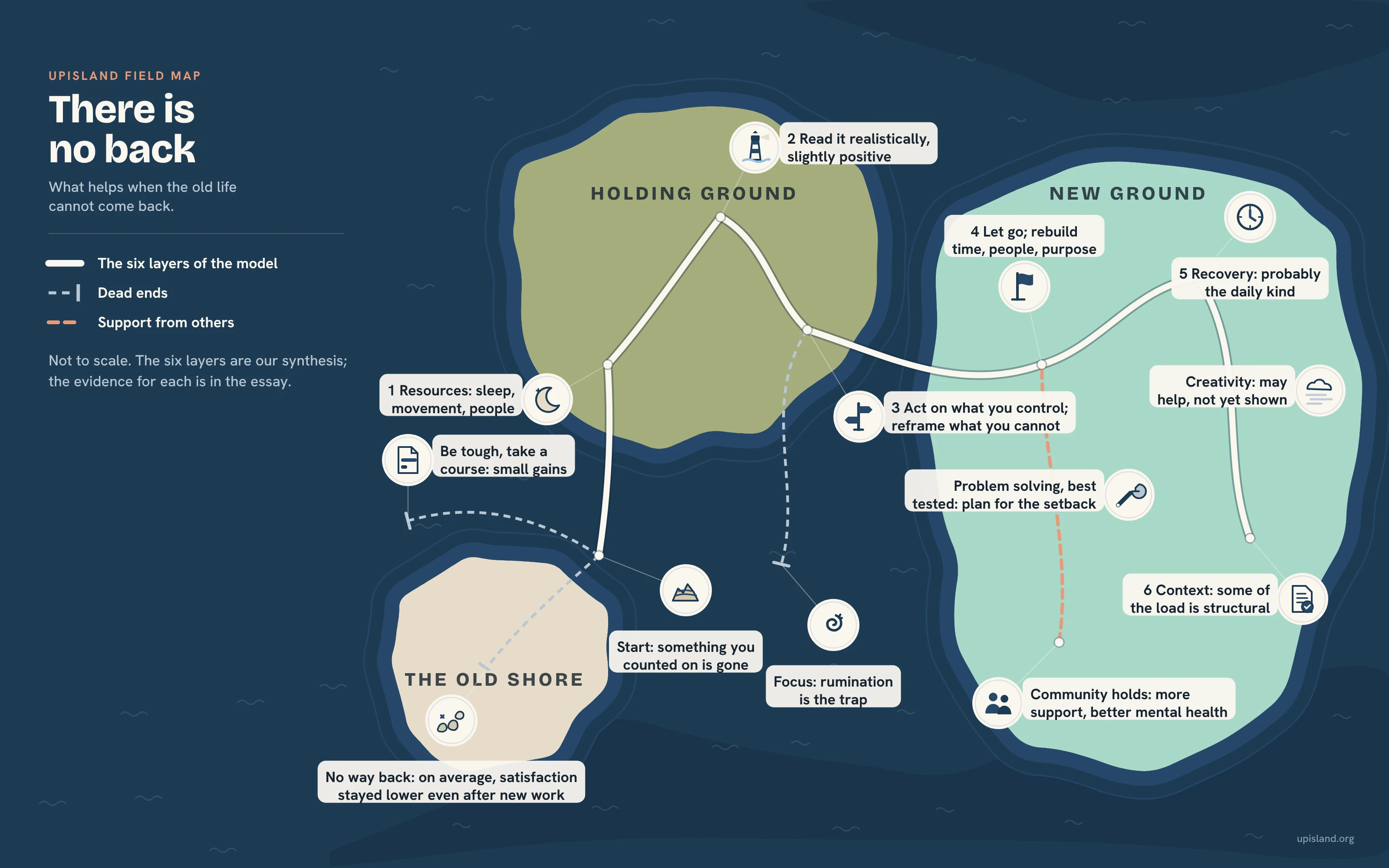
We put these findings together into a model. It has six layers, and each one is something a person, or the people around them, can work on. The layers are our synthesis; the evidence under each one is not.
1. Resources. In this model, sleep, movement and people are the reserve you draw on. In one trial with adults aged 60 or older who had insomnia, therapy for insomnia roughly halved new or returning major depression compared with sleep education alone. Across 49 prospective studies, physically active people had lower odds of developing depression.
2. Reading the situation. The way you appraise what happened matters. Researchers in Mainz found that appraising stressors in a realistic to slightly over-positive way predicted more resilient outcomes, meaning fewer mental-health problems relative to the stress people faced, over several years.
3. The switch. Act on the parts you control; reframe the parts you cannot. In one study, the ability to reframe a situation went with less depression when the stress was uncontrollable and with more depression when it was controllable. Catch rumination, and do not carry the whole thing alone.
4. Rebuilding. Let go of what cannot come back, and take up something new. Across 31 samples, letting go of goals was only weakly linked to quality of life, and taking up new goals had the stronger link. In people already at risk of depression, letting go went with more symptoms.
Then rebuild what the loss took with it. A job is also a clock, a social circle and a reason to leave the house: time structure, contact, shared purpose and activity each predict mental health on their own. As for meaning: after 9/11, finding it predicted fewer post-traumatic stress symptoms over two years, and searching for it predicted more.
5. Recovery. Detachment from work can be trained. The health gains from vacations fade soon after people return. Since long breaks fade, the recovery that lasts is probably the routine kind.
6. Context. Some of the load is structural. The World Health Organization defines burnout as the result of chronic workplace stress that has not been successfully managed. In studies of physicians, interventions aimed at the organisation did better than those aimed at the individual.
5. Forward
Cascio and Bob Johansen have since sketched a response to the brittle world. It is a futurist's framing, untested. Two of its words, bendable and interconnected, line up with what the research above found.
The clocks in this story run at different speeds. A job can end in an afternoon. The German panel followed people for fifteen years, and on average life satisfaction did not fully come back, even after they found work. The Michigan trials measured their effect over two years. Recovery, if it is to last, probably runs on a daily clock.
That is why "there is no back" is a more hopeful sentence than it sounds. It takes away a promise nobody can keep. It leaves the parts that can be built: the next step worked as a problem, attention brought back from the loss, people who are there, a regular point where the load is put down, and a new aim to replace the one that ended.
Start small. Pick the next concrete step, plan for the setback before it comes, and tell one person about it.